Industrial and automotive nonwovens are widely used in applications such as automotive interiors, filtration, insulation, and protective fabrics. But which machines are essential to produce these nonwovens efficiently and at high quality?
Producing nonwoven fabrics involves several key steps: fiber opening, web formation, bonding, and finishing. The choice of machinery directly affects product consistency, mechanical strength, and suitability for industrial or automotive applications. Understanding the different types of machines helps manufacturers optimize production efficiency, maintain quality, and meet demanding specifications.
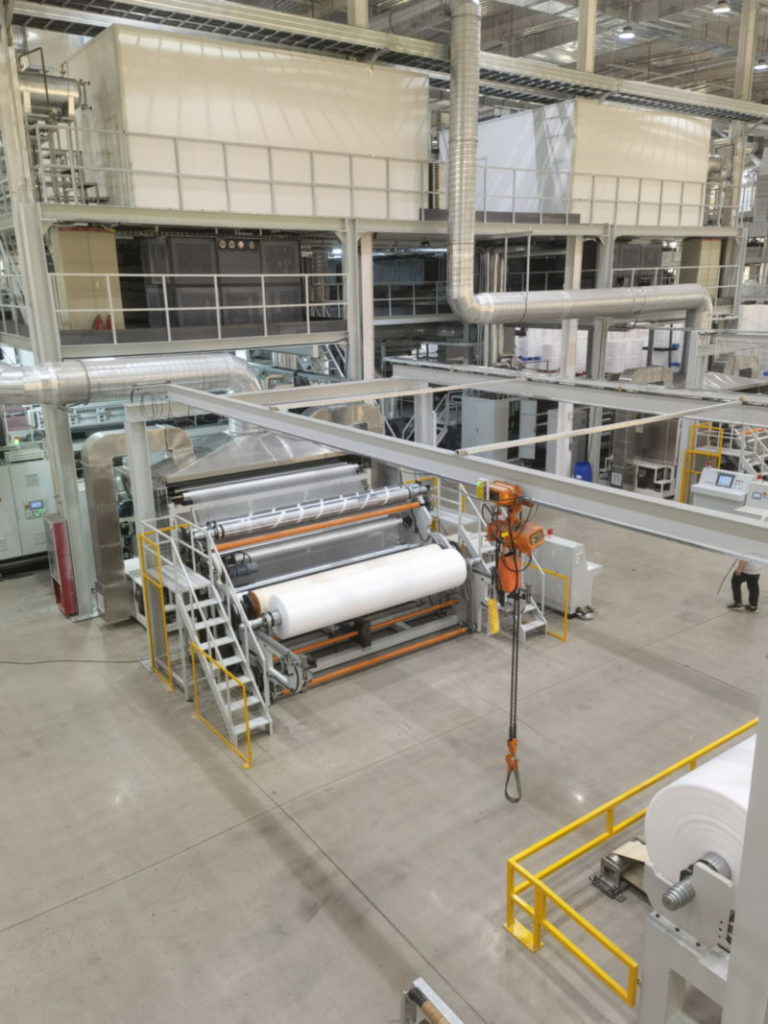
Core Machines for Industrial Nonwoven Fabric Production
Carding Machines
Carding machines are essential for the initial fiber preparation. They open raw fibers, align them into a uniform web, and remove impurities. Proper carding ensures consistent thickness, strength, and uniformity, which is vital for applications such as industrial insulation, protective pads, and automotive soundproofing materials.
Spunbond Machines
Spunbond machines produce continuous filament nonwovens with high mechanical strength. They are widely used in automotive interiors, filtration, and geotextiles. The spunbond process allows the production of lightweight fabrics that can withstand significant mechanical stress, making them ideal for high-performance industrial uses.
Needle Punch Machines
Needle punch machines mechanically interlock fibers using barbed needles. This process is suitable for heavy-duty nonwovens applied in automotive carpet backings, insulation pads, and protective layers. Needle punching ensures structural stability, high durability, and excellent dimensional consistency.
Hydroentanglement Machines
Hydroentanglement, also known as spunlace, uses high-pressure water jets to entangle fibers. This produces soft and flexible nonwovens ideal for automotive headliners, wipes, and filtration media. Hydroentanglement results in a smooth texture, excellent drape, and uniform thickness.
For industrial-scale solutions, our nonwoven machines deliver precision, reliability, and consistent output for diverse nonwoven applications.
Specialized Machines for Automotive Nonwovens
Spunmelt Machines
Spunmelt machines combine spunbond and meltblown processes to create composite nonwovens. These fabrics are highly durable and are used in automotive air filters, battery separators, insulation panels, and protective layers. Spunmelt technology allows production of high-performance materials with controlled porosity and tensile strength.
Thermal Bonding Machines
Thermal bonding machines use heat and pressure to fuse fibers without adhesives. They are widely applied in automotive interior panels, door linings, and other structural components where durability, dimensional stability, and uniform thickness are required.
Laminating and Coating Machines
Laminating machines integrate multiple nonwoven layers or add films for improved mechanical performance. Coating machines apply functional layers such as adhesives, flame retardants, or water-repellent coatings. Laminated nonwovens enhance durability and performance, making them suitable for automotive interiors and specialized industrial applications.
For efficient automotive nonwoven production, our fabric making machine ensures high-speed, precise output with optimized fiber management.
Material Considerations for Nonwoven Applications
Nonwoven performance is highly dependent on fiber type and web structure. Common fibers include polypropylene, polyester, and recycled fibers. Choosing the correct fiber type ensures optimal mechanical strength, uniformity, and compatibility with bonding processes.
Recommended Material-Machine Combinations
| Nonwoven Type | Fiber Type | Application Area | Machine Type |
|---|---|---|---|
| Spunbond Filtration | Polypropylene | Automotive air filters | Spunbond Machine |
| Needle Punch Insulation | Polyester | Engine bay soundproofing | Needle Punch Machine |
| Decorative Interiors | Polypropylene / Blended | Dashboard, door panels, headliners | Laminating & Coating Machine |
| Heavy-Duty Industrial Pads | Recycled Fiber | Conveyor belts, insulation pads | Hydroentanglement Machine |
Table 1: Recommended Fiber-Machine Combinations for Industrial and Automotive Nonwovens
For custom production guidance, get in touch with our experts to select the ideal machine configuration for your project.
Optimizing Nonwoven Production
Web Formation and Fiber Distribution
Uniform fiber distribution ensures consistent fabric properties. Carding and airlay systems align fibers evenly before bonding, reducing defects and improving fabric strength.
Bonding and Strengthening
Mechanical, thermal, or hydroentanglement bonding increases durability and dimensional stability. Selecting the appropriate bonding method depends on end-use requirements and performance targets.
Automation and Quality Control
Modern production lines integrate automated monitoring, tension control, and inline quality inspection. Automation reduces waste, minimizes downtime, and ensures consistent quality for industrial and automotive nonwovens.
For large-scale and precise production, our nonwoven fabric machine ensures uniform fiber control, high efficiency, and reliable output.
Frequently Asked Questions
Q1: Which machine is best for automotive headliners?
A: Hydroentanglement or spunbond machines are ideal for soft, flexible fabrics with uniform thickness.
Q2: How do I choose between needle punch and spunbond machines?
A: Needle punch machines are best for heavy-duty, high-strength fabrics, while spunbond machines are suitable for lightweight, uniform nonwovens.
Q3: Can multiple fiber types be combined in a single nonwoven?
A: Yes, composite layers can be combined using lamination or spunmelt machines for enhanced performance.
Q4: What is the advantage of laminating nonwovens?
A: Lamination improves mechanical performance, durability, and allows functional coatings for industrial and automotive applications.
Why Choose Guanlong for Nonwoven Machines
Guanlong is a trusted nonwoven machines manufacturer offering tailored solutions for industrial and automotive nonwovens. Our production lines feature:
- High-performance carding, spunbond, and hydroentanglement systems
- Automated monitoring and process control
- Scalability for high-volume production
Guanlong delivers machines that ensure efficiency, consistent quality, and long-term reliability. Our engineering team provides customized solutions to optimize production, performance, and cost-effectiveness.